

The costs that blindside new owners are rarely the big obvious ones. They are dental work and corrective farrier visits in year one, the property costs that boarding was quietly absorbing if you keep a horse at home, and the slow creep of costs as a horse ages into retirement. Most published estimates put total annual cost of ownership at $5,000 to $15,000 for a single healthy horse, and the gap between that estimate and what a first-year owner actually spends usually comes from these overlooked categories, not from the headline board or feed bill. Here is where each one shows up and why it gets missed.
Costs that hit in year one and nobody warns you about
A new horse, especially one bought without a full veterinary history, often needs dental floating and sometimes corrective work in its first months on your property, on top of the routine annual exam most budgets already expect. If the horse arrives barefoot or with neglected feet, the first few farrier visits can involve corrective trimming that costs more than the routine six-to-eight-week schedule that follows once the feet are balanced. A vet-out visit at arrival, to establish a baseline and check vaccination status, is another cost that a first two weeks with a new horse checklist should include but a purchase-price budget usually does not. None of these are exotic. They are simply front-loaded into the first ninety days, which is exactly when a new owner’s budget has the least slack, and they are one more reason common mistakes buying your first horse treats a pre-purchase exam as worth its cost regardless of price point: it catches some of these year-one costs before they become a surprise.
The home-keep trap: what boarding was quietly covering
Anyone moving from boarding to keeping a horse at home is trading a single monthly bill for a list of property costs that do not arrive as one line item. Fencing needs regular repair and eventual replacement. Pasture needs rotation, reseeding, or supplemental hay when grazing runs thin, and a horse can go through roughly fifteen to twenty pounds of hay a day when pasture alone will not cover it. Hay needs dry storage, which is itself a cost if you do not already have a barn or shed for it. Bedding, manure management, and basic pest control add up over a full year even though each one looks small individually. None of this makes home-keep the wrong choice. It makes it a different cost structure, one that shows up as property maintenance and your own labor rather than as a monthly invoice, and it deserves the same budget line a boarding bill would get.
Costs tied to the horse getting older, not to anything going wrong
A horse does not need to get sick to get more expensive. Joint support, dietary adjustments for a horse that is losing condition on the same feed it always ate, and more frequent dental work are all normal parts of aging, not signs of a problem. None of this shows up in a first-year budget built around a young, sound horse, but it is worth planning for from the start if you expect to keep the same horse for a decade or more. How old is too old to buy a horse covers how to evaluate an older horse’s condition directly; the cost side of that same question is simply that maintenance costs rise gradually with age rather than arriving as a single expense. This matters even for owners who buy young: a horse kept for ten or fifteen years will eventually move into this cost category, so it is worth building the expectation in early rather than treating it as a future problem to deal with later.
Bedding, pest control, tack replacement: the small recurring costs that add up
Individually, none of these categories breaks a budget. Bedding needs replacing on a schedule that depends on stall time and season. Fly control and general pest management are seasonal but real costs, especially in warm, humid regions. Tack wears out and needs replacing or repairing, particularly leather goods used daily and blankets that take a season of weather. None of these appear on a purchase-price estimate or even most monthly-cost calculators, because each one is small enough to seem negligible. Added together across a full year, they are a real and recurring category, and the guides that quote a $5,000 to $15,000 annual range are generally including them as part of that lower-to-middle band.
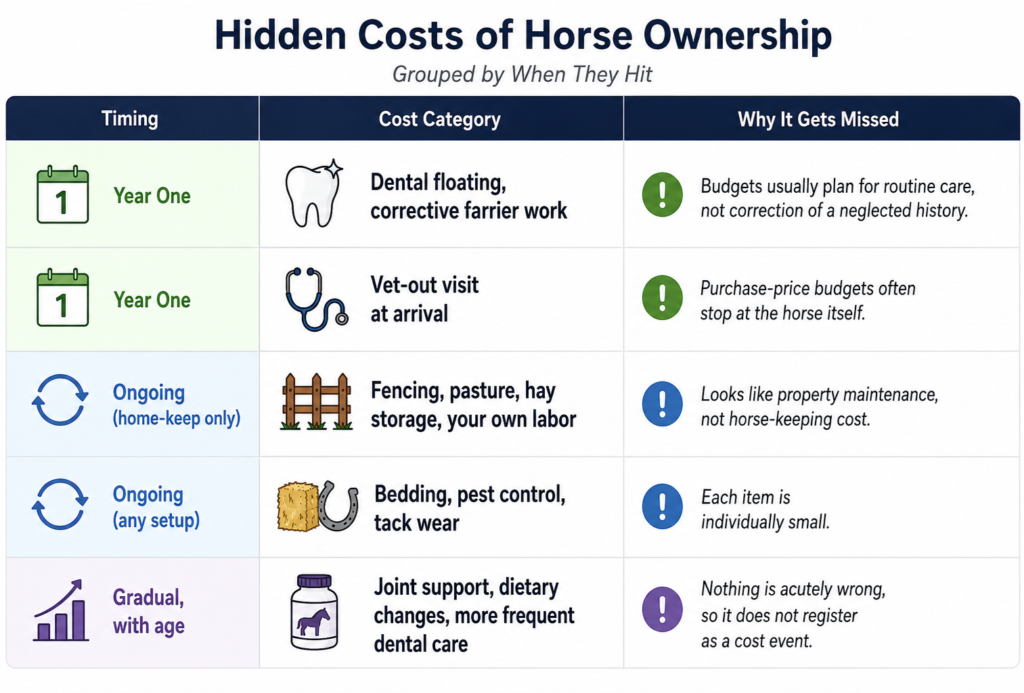
Hidden costs, grouped by when they hit
| Timing | Cost category | Why it gets missed |
|---|---|---|
| Year one | Dental floating, corrective farrier work | Budgets usually plan for routine care, not correction of a neglected history |
| Year one | Vet-out visit at arrival | Purchase-price budgets often stop at the horse itself |
| Ongoing (home-keep only) | Fencing, pasture, hay storage, your own labor | Looks like property maintenance, not horse-keeping cost |
| Ongoing (any setup) | Bedding, pest control, tack wear | Each item is individually small |
| Gradual, with age | Joint support, dietary changes, more frequent dental care | Nothing is acutely wrong, so it does not register as a cost event |
Grouping the list this way is more useful than a flat checklist, because the response is different for each column. Year-one costs are a one-time budget line to plan for before the horse even arrives. Home-keep costs are a structural choice, not a surprise, once you recognize them as the trade for not boarding. Age-related costs are the one category worth planning for years in advance, even while the horse is young and inexpensive to keep.
How to build a buffer instead of getting surprised
The fix for all of the above is not a bigger single number; it is a buffer line in the budget that covers “the things I have not thought of yet.” A reasonable approach is to add ten to fifteen percent on top of a category-by-category estimate (see what owning your first horse actually costs and demands for how to build that base estimate) specifically to absorb the year-one costs and small recurring items described here. That buffer will not cover a major veterinary emergency, which deserves its own separate reserve, but it will keep the ordinary surprises from feeling like budget failures.
FAQ
Is boarding actually cheaper than keeping a horse at home?
Not necessarily. Boarding converts many of these costs into a single predictable monthly bill, while home-keep spreads them across property maintenance and labor. Which is cheaper depends on whether you already own suitable land and how much of the labor you can do yourself.
What is the most commonly underestimated cost?
Across published cost guides, dental and corrective farrier work in the first year, and the slow rise in maintenance costs as a horse ages, are the two categories most consistently missing from first-time budgets.
Do these hidden costs apply the same way to a leased horse?
Some do and some do not. A lease typically shifts major and long-term costs like aging-related maintenance to the owner, but day-to-day costs such as farrier, feed, and minor veterinary care are commonly the leaseholder’s responsibility under most lease agreements, so it is worth confirming exactly what a specific lease covers.
Is there a way to estimate the buffer more precisely than “ten to fifteen percent”?
Not without your own data. The most reliable way is to track actual spending for six months to a year against your original worksheet, then adjust the buffer for future years based on what really happened, rather than trying to estimate it more precisely up front than the categories themselves allow.
Sources consulted: published horse-ownership cost breakdowns and guides covering property, feed, and long-term care costs, cross-checked against the cost categories in what owning your first horse actually costs and demands.