

The honest range for a first year of horse ownership is roughly $8,600 to $26,000, or about $250 to $2,500 a month, once purchase price, board or home-keep, feed, farrier, routine vet care, and insurance are all counted. Nobody can hand you a single number, because the range depends on whether you board or keep the horse at home, what region you’re in, and how much goes wrong. What follows is a category-by-category way to build your own figure instead of guessing from someone else’s average.
Why nobody can give you one number
Ask five horse owners what a horse costs and you will get five different answers, and all five can be correct for their own situation. A horse boarded at a full-service barn in a high-cost region and a horse kept at home on paid-off pasture can differ by thousands of dollars a year for the same level of care. Published cost guides converge on a wide band, not a point: purchase price of $1,000 to $5,000 or more, one-time tack and equipment of $500 to $2,000, and an all-in annual cost commonly cited between $8,600 and $26,000. That spread is not the guides being vague. It reflects a real difference between a modest home-keep setup and a full-board arrangement with routine competition or training costs layered in. The gap that catches new owners is not the sticker price. It is the set of costs that are entirely foreseeable and simply do not get budgeted for, because the purchase is what everyone plans around and the year that follows is not. We have not found a cost survey that puts a defensible multiplier on how far first-year spending overshoots expectation, so this guide does not quote one. It closes the gap the other way, by naming every recurring category before you meet it.
The one-time costs: buying the horse and the tack you actually need
The purchase price itself typically runs $1,000 to $5,000 for a suitable, sound beginner or family horse, with more specialized bloodlines, training, or show records pushing well past that. Separately, a first-time buyer needs a starter set of tack and equipment: a well-fitting saddle and pad, a bridle, halters and lead ropes, blankets appropriate to the climate, and basic grooming and first-aid supplies. Guides commonly put this starter kit at $500 to $2,000, and used or consignment tack can bring that down meaningfully without compromising fit or safety. A pre-purchase veterinary exam is a separate, worthwhile one-time cost that belongs in this category too; skipping it to save a few hundred dollars is one of the more expensive mistakes a new buyer can make (see common mistakes buying your first horse for how that specific mistake plays out). On the tack side, used or consignment equipment is a legitimate way to control this cost, provided saddle fit is checked by someone qualified to check it; a cheaper saddle that does not fit the horse tends to create both a welfare problem and a second purchase down the line, which erases whatever the discount saved.
The recurring bill: board or home-keep, feed and hay
This is where the largest ongoing cost sits, and where boarding versus home-keep creates the biggest split. A full-board arrangement, where the barn supplies feed, turnout, and daily care, is commonly quoted in a wide range depending on region and services included. Keeping a horse at home trades that monthly bill for property costs: pasture and fencing maintenance, hay storage, bedding, and your own labor, which does not show up as a dollar figure but is real. On feed specifically, published guides put hay and feed costs at roughly $150 to $500 a month depending on the horse’s needs, the season, and local hay prices. Neither path is categorically cheaper; each simply moves the cost between a monthly bill and a property investment, and the right comparison is your actual quotes, not a national average. Whichever path you choose, budget for a settling-in period too; the first two weeks with a new horse covers the arrival costs, like an initial vet-out visit and a gradual feed transition, that land inside this same recurring-cost category before a routine sets in.
The costs new owners forget: farrier, routine vet, dental, and the emergency fund
Farrier visits, needed roughly every six to eight weeks, commonly run $400 to $1,200 a year depending on whether the horse is barefoot or shod. Routine veterinary care, covering an annual wellness exam, vaccinations, and dental floating, is a smaller but genuinely recurring line item that first-time budgets sometimes leave out entirely. The line item that does the most damage to a first-year budget, though, is the one nobody plans for: an emergency vet fund. Even a healthy horse can have an episode of colic, a fracture, or an eye injury, and cost-of-care sources put a serious emergency, such as colic surgery, at up to roughly $10,000. Building a modest emergency reserve into the first-year budget, rather than treating a vet emergency as a hypothetical, is the single change most likely to keep a real first year on budget.
Insurance: what it costs and what it actually covers
Mortality insurance, which covers the horse’s purchase value if it dies or must be euthanized, is commonly quoted at around 3 to 5 percent of the horse’s value per year, meaning a $10,000 horse might run roughly $300 to $500 a year to insure. Major medical or surgical coverage is typically a separate policy or rider, with its own premium and payout limits, and it is worth reading the exclusions closely before assuming a policy covers a specific emergency. Insurance does not remove the need for an emergency fund; it changes what that fund needs to cover. For a longer look at whether coverage is worth it in practice, see how old is too old to buy a horse, which touches on how age affects both insurability and maintenance cost.
First-year costs at a glance
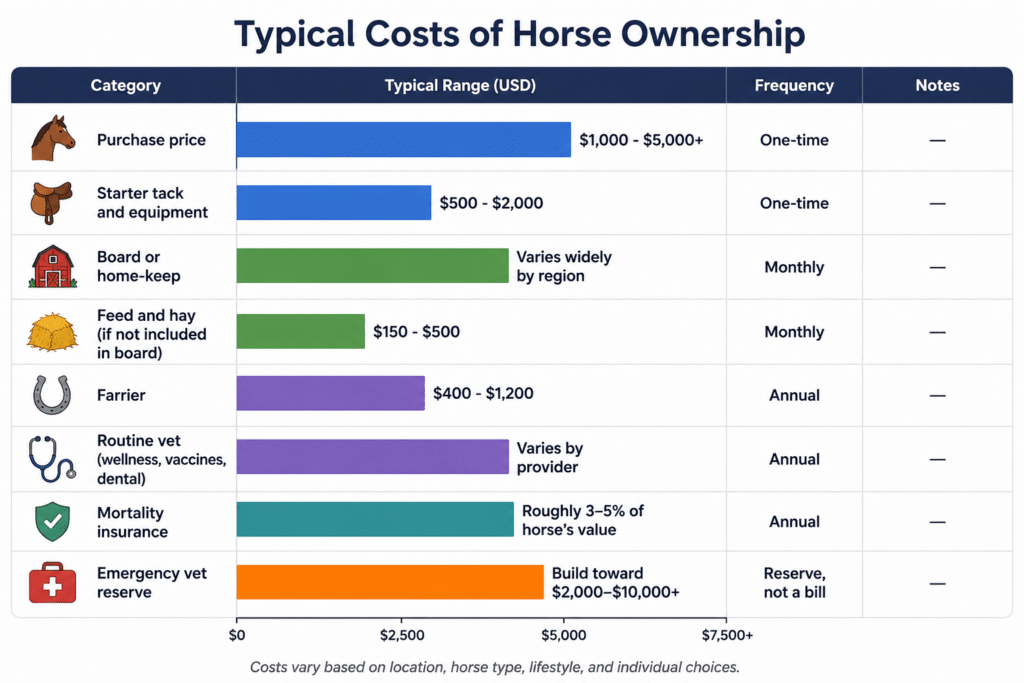
| Category | Typical range | Frequency |
|---|---|---|
| Purchase price | $1,000 – $5,000+ | One-time |
| Starter tack and equipment | $500 – $2,000 | One-time |
| Board or home-keep | Varies widely by region | Monthly |
| Feed and hay (if not included in board) | $150 – $500 | Monthly |
| Farrier | $400 – $1,200 | Annual |
| Routine vet (wellness, vaccines, dental) | Varies by provider | Annual |
| Mortality insurance | Roughly 3-5% of horse’s value | Annual |
| Emergency vet reserve | Build toward $2,000-$10,000+ | Reserve, not a bill |
This table is a starting point, not a quote. Every line depends on your region, your horse’s needs, and the specific barn or vet you use, which is exactly why the worksheet approach below matters more than the table itself.
Building your own number: a simple worksheet approach
Rather than adopting a single quoted total, build the number in five lines: purchase price (one-time), tack and starter equipment (one-time), board or home-keep (monthly, times twelve), feed if not included in board (monthly, times twelve), and a combined farrier, routine vet, and emergency reserve line (annual). Get real quotes for the board or home-keep line from barns or suppliers in your own region rather than relying on a national figure, since that single line varies more than any other. Add insurance if you plan to carry it. The result will not match anyone else’s number, and it should not; it is built from your actual situation rather than someone else’s average. Before finalizing a budget, it is worth reading the hidden costs of horse ownership, which covers the categories that tend to fall outside even a careful worksheet like this one.
FAQ
Is $200 a month realistic for a horse?
Not usually as a full picture. $200 a month can cover feed alone in some situations, but once board or home-keep costs, farrier visits, and routine vet care are added, most published estimates land well above that figure for a complete monthly cost.
What’s the single biggest budget-buster in a first year?
Across cost guides, the most commonly cited gap is an unbudgeted veterinary emergency, such as colic, a fracture, or an eye injury, which can run into the thousands and is rarely included in an initial estimate.
Does leasing a horse avoid these costs?
Leasing can reduce or eliminate the purchase price and some tack costs, but board, feed, farrier, and day-to-day expenses are usually still the leaseholder’s responsibility under most lease arrangements, so it reduces the total rather than eliminating it.
Are these figures the same everywhere?
No. Every range in this guide comes from published cost surveys and guides, and every one of them notes that region, boarding availability, and local hay and labor costs shift the numbers substantially. Treat these as a starting framework to check against quotes in your own area, not a fixed price.
Should I budget the same amount every month, or expect it to change?
Expect it to change. Feed needs shift with the season, farrier and vet costs land on their own schedules rather than evenly across twelve months, and an emergency, if one happens, arrives without warning. A worksheet built on annual totals divided into a rough monthly average is more realistic than assuming every month costs the same.
Sources consulted for cost ranges: published horse-ownership cost guides and calculators (including CareCredit’s cost-of-horse-ownership overview and equine-industry cost breakdowns from Mad Barn and university extension cost-of-keeping-a-horse publications).